
You already know what it feels like.
You close your eyes, the room is dark, everything is quiet — and your brain decides that right now is the perfect time to replay every awkward conversation from the past five years.
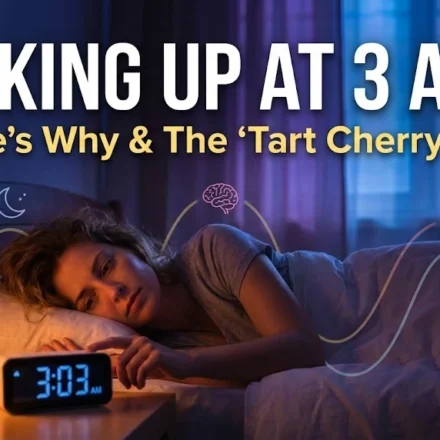
Or maybe you fall asleep just fine. But by 2 or 3 AM, something wakes you up and sleep is gone. Just like that.
Most people who struggle with sleep aren’t lazy or dramatic. They’re exhausted people who’ve tried everything the internet told them to try and still wake up feeling like they were never in bed at all.
This article isn’t going to tell you to “drink warm milk and relax.” It’s going to tell you what’s actually going on inside your body when sleep breaks down — and nine natural remedies, backed by real research, that can help put it back together.
Here’s what most people don’t realise.
Sleep isn’t just one long, flat state you fall into and climb out of. It moves through stages — light sleep, deep sleep, REM sleep — cycling through all night long. The deep stage is where your body does its actual repair work. Muscle recovery, memory consolidation, brain cleanup. The serious stuff.
And it’s the deep stage that breaks down first.
Stress does it. Late-night screens do it. Irregular bedtimes do it. Even low levels of certain nutrients do it — quietly, gradually, until you start waking up wondering why you feel worse than before you went to bed.
The good news is that most of these causes respond to natural correction. Not overnight. Not dramatically. But steadily — which is honestly how the body likes to heal anyway.
So Here Are the 9 Natural Sleep Remedies That Actually Work
Start with one. Try two. But please — read all nine before you decide which ones are worth your time.
1. Magnesium
Magnesium is the one that most people are deficient in without knowing it, and it does something no other mineral quite does — it activates GABA, the brain’s main “calm down” signal.
Without enough magnesium, your nervous system stays slightly agitated even when you’re trying to rest. Clinical research has found that magnesium can reduce insomnia symptoms, and it works particularly well if you’re the kind of person who lies awake with a racing mind or general restlessness. ScienceInsights
Magnesium glycinate is the gentlest form on the stomach. If you try nothing else on this list, try this one first.
READ MORE: Best Magnesium for Sleep: Which Type Actually Helps You Stay Asleep All Night
2. Tart Cherry Juice
This one sounds too simple to be real, and yet the research keeps pointing back to it.
Tart cherries naturally contain melatonin — the hormone that regulates your sleep-wake cycle — as well as anthocyanins, which have antioxidant and anti-inflammatory properties that may help with sleep disorders linked to chronic inflammation. nih
They also contain tryptophan, the amino acid your body converts into serotonin and then into melatonin on its own internal schedule.
A study in older adults with insomnia found that drinking tart cherry juice blend twice daily — once in the morning, and once an hour or two before bed — showed measurable improvements in sleep quality. healthline
It won’t hit like a sedative. But it supports the system your body already has, which is a better long-term approach than overriding it.
READ MORE: What Is the 30 Second Cherry Trick for Sleep — And Does It Actually Work?
3. Valerian Root
Valerian has been used for sleep and anxiety for centuries, and science has been slowly catching up to what traditional medicine already knew.
Some high-quality studies found that valerian may help people fall asleep faster and feel like they’re sleeping better — though the results aren’t consistent across every study. National Geographic
It tends to work best for people whose main barrier to sleep is a busy, anxious mind rather than physical restlessness. If you lie awake thinking, this is worth trying.
4. L-Theanine
L-theanine is an amino acid found naturally in green tea, and it does something most sleep aids don’t — it calms you without making you drowsy.
It encourages alpha brain wave activity, the same relaxed-but-alert state your mind settles into just before sleep arrives. It promotes relaxation without sedation, which makes it a good fit for people who aren’t tired enough at bedtime, not because they don’t need sleep, but because their nervous system hasn’t shifted gears yet. Dr. Axe
5. Chamomile
There’s a reason chamomile tea has been a bedtime ritual across dozens of cultures for hundreds of years.
It contains a compound called apigenin that binds to receptors in the brain and produces a mild calming effect. The evidence isn’t as strong as it is for magnesium, but it’s real — and for many people, the ritual of making and drinking a warm cup an hour before bed is part of the signal that the day is done.
Sometimes the body responds to cues as much as to chemistry.
6. Lavender Aromatherapy
Scent travels directly to the limbic system — the part of your brain that processes emotion and regulates the nervous system. Lavender, specifically, has been studied more than any other scent in sleep research.
Studies using diffused lavender oil in the bedroom showed measurable improvements in sleep quality, particularly in people whose sleep was disturbed by anxiety or restlessness.
This isn’t pseudoscience. The mechanism is real — your nose has a faster line to your nervous system than most people realise.
7. A Consistent Sleep Schedule
No supplement on earth can do what a consistent bedtime can.
Your circadian rhythm — the internal clock that tells your body when to feel alert and when to feel sleepy — is built on pattern recognition. It expects the same signals at the same times every day. When you give it that consistency, it starts releasing melatonin and dropping your core body temperature on schedule, automatically.
When you don’t, it gets confused. And a confused circadian clock means shallow sleep, frequent waking, and that feeling of never being fully rested no matter how long you stay in bed.
Pick a wake-up time and hold it — even on weekends. The rest of the system tends to follow.
8. Breathing and Relaxation Techniques
This one gets underestimated because it sounds too easy to work.
Slow, deliberate breathing — specifically breathing out longer than you breathe in — activates your parasympathetic nervous system, the part responsible for rest and digestion. It physically cannot coexist with the stress response.
This is the foundation of cognitive behavioural therapy for insomnia, which is the most evidence-backed treatment for sleep difficulty that exists — more effective than most prescription sleep medications in long-term studies. Five minutes of slow breathing before bed is a real intervention, not a feel-good trick.
9. Reducing Blue Light Before Bed
Screens emit blue-wavelength light that tells your brain it’s still daytime. Not metaphorically — it literally suppresses melatonin production.
Even 30 minutes of scrolling before bed can push your body’s melatonin peak back by an hour or more. That’s an hour of deep sleep you lose from the front of the night, when deep sleep is most available.
Dimming lights, using warmer-toned bulbs in the evening, and putting your phone down an hour before bed is not old-fashioned advice. It’s biology.
Here’s the honest truth about all of this.
None of these work like a switch. Anyone who tells you a single supplement will transform your sleep overnight is selling something.
What actually works is layering. A consistent bedtime, magnesium, a wind-down routine, maybe tart cherry juice a couple of hours before bed. Combining two or three of these tends to produce better results than relying on any single one, because they work through different mechanisms — GABA activation, melatonin support, temperature regulation, nervous system calming. ScienceInsights
Give it two to three weeks of consistency before deciding whether something works. That’s how long it takes for your circadian rhythm to start genuinely resetting.
And if sleep difficulty has been going on for months, if it’s affecting your work, your mood, your relationships — please talk to a doctor. Natural remedies are a genuinely useful tool. They are not a substitute for professional care when that’s what’s actually needed.
But for most people reading this, the problem isn’t a medical one. It’s a lifestyle mismatch between how busy your days are and how little runway you give your body to slow down before bed.
Start there. Give your nervous system a reason to trust that the night is safe. The sleep usually follows.
THE 30-SECOND “CHERRY TRICK” THAT STOPS 3 AM WAKE-UPS AND RACING THOUGHTS
A doctor–recommended technique that targets cortisol at its source — stopping the racing thoughts and resetting your sleep cycle naturally. No pills. No prescriptions. Works the very first night.

Most people sleep 6–7 hours straight the very first night they try it