
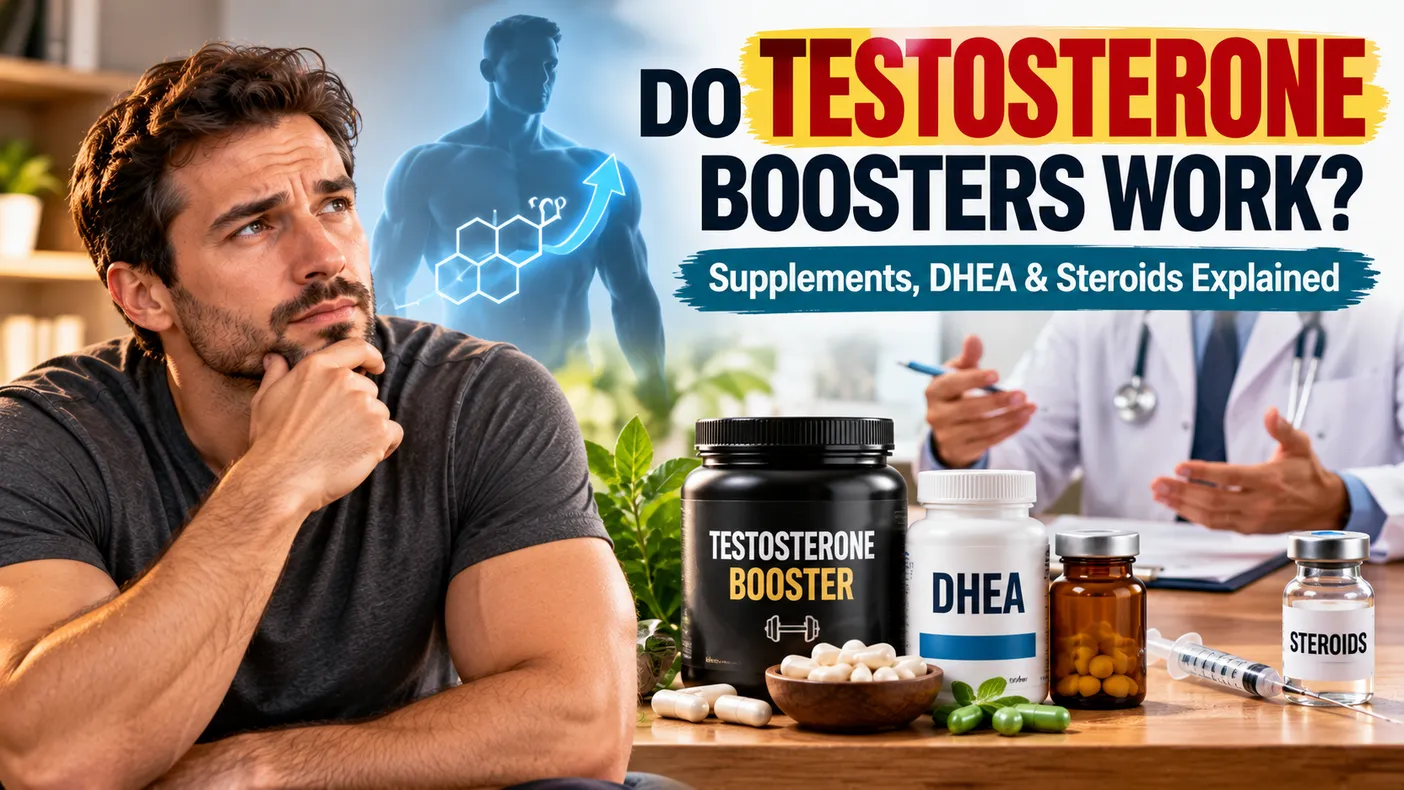
The ad shows a man with huge arms and one big promise. Skyrocket your testosterone. Burn fat. Get your drive back. All in 30 days.
It sounds great, especially if you’ve been tired and flat lately. So you do what most people do. You search: do testosterone boosters work?
Here’s the short answer. The evidence is much weaker than the ads, and a few popular ingredients can cause real harm.
This guide shows what doctors say, scores the most common ingredients, and gives you a 6-point checklist to use before you buy anything.
Short answer: Mostly no. A University of Utah urologist says no supplement has been shown to make a real difference in testosterone, and some may be harmful. Fixing a true shortage, like low vitamin D or low zinc, is the main exception. Lifestyle changes have far better evidence.
What Doctors Say About Testosterone Boosters
A urologist at University of Utah Health puts it plainly. No supplement has been shown to make a real difference, and some may be harmful.
That surprises many men, because “booster” sounds so scientific. But most boosters don’t contain any testosterone. They’re blends of vitamins, minerals, and herbs, packaged with big promises.
Here’s another thing worth knowing. In the US, the FDA doesn’t test supplements for safety or effectiveness before they go on sale. Companies can sell a product first, and problems get sorted out later.
So what does work? The same Utah urologist points to lifestyle changes: losing extra weight, lifting weights, eating well, and sleeping enough. Those have far better evidence behind them.
Related: 8 Ways to Boost Testosterone Naturally in Men (What Actually Works)
Natural Testosterone Boosters: The Ingredient Scorecard
Most boosters lean on the same handful of ingredients. Here’s how they score, based on the sources listed at the end of this article.
| Ingredient | What labels claim | What the evidence shows | Who it might matter for |
|---|---|---|---|
| DHEA / ANDRO | Raises testosterone and builds muscle | Unproven, with safety concerns. The body can turn these into other hormones, but benefits for men with normal levels aren’t shown. Both the Utah urologist and Air Force Medical Service raise safety concerns. | Mostly no one without a doctor’s guidance |
| Ashwagandha | Lowers stress and raises testosterone | Promising, but early. One small study found a rise in testosterone. Research is limited. | Stressed men who talk to a doctor first |
| Vitamin D | Supports healthy testosterone | Promising, if you’re low. Low vitamin D is linked to lower testosterone. Extra doesn’t appear to help men with normal levels. | Men with a confirmed low vitamin D level |
| Zinc | Needed to make testosterone | Promising, if you’re low. A true shortage can lower testosterone, and fixing it can help. | Men who are truly low on zinc |
| Magnesium | Supports hormones and sleep | Promising, but limited. Small studies, and any benefit seems tied to being low. | Men with low intake or low levels |
A few notes on the table:
- “Promising” isn’t proof. It means early or mixed research, and it only matters for most men if a blood test shows you’re low.
- Upper limits matter. Adult upper limits are about 40 mg a day for zinc and 350 mg a day for magnesium from supplements. More is not better, and too much can cause side effects.
- Other popular ingredients include tribulus, fenugreek, D-aspartic acid, and tongkat ali. Research on these is small and mixed, and none has been shown to reliably raise testosterone in men with normal levels.
Are Testosterone Boosters Safe?
It depends on the product, the dose, and you. These are the most common risks:
- Unlisted ingredients. Some products sold for bodybuilding have been found to contain drugs that aren’t on the label.
- Too much of a good thing. Stacking several products can push you past safe limits without you noticing.
- Medicine interactions. Herbs and minerals can interact with prescription drugs.
- Hiding a real problem. If your symptoms come from sleep apnea, depression, or a thyroid issue, a booster won’t fix them and may delay the right care.
Talk to your doctor before you start, especially if you have a heart, prostate, or liver condition, or if you take any medicine.
Related: 5 Signs of Low Testosterone in Men (and When to Get Tested)
DHEA Side Effects and Why Doctors Warn About It
DHEA is a hormone your body makes naturally. Andro, short for androstenedione, is a close relative. Supplements with either one try to give your body raw material to turn into testosterone.
The problem is that your body may turn it into other hormones too, including estrogen. That’s where trouble can start. Reported DHEA side effects include:
- Acne and oily skin
- Mood changes and trouble sleeping
- Headaches and an upset stomach
- Breast tissue growth from hormone imbalance
- Possible concerns for hormone-sensitive conditions, including prostate problems
The Utah urologist says DHEA may be harmful. Air Force Medical Service also warns about the risks of DHEA and andro. In the US, andro is classed as a controlled substance, and many sports organizations ban DHEA.
Ashwagandha and Testosterone: What We Know
Ashwagandha is an herb long used in traditional medicine, mostly for stress. The Hospital of Central Connecticut points to one study where it was linked to higher testosterone.
One study isn’t enough to count on, though. Most research on ashwagandha and testosterone is small, short, and mixed in quality. It may help some men feel less stressed, and lower stress can help sleep and mood. That’s not the same as proof it raises testosterone.
Keep in mind: Side effects can include an upset stomach and drowsiness. Rare cases of liver problems have been reported. It may also interact with some medicines, including thyroid, sedative, and diabetes drugs. Check with your doctor first.
Steroid Side Effects and Legal Risk
Steroids are a different category entirely. They aren’t supplements. They’re powerful drugs, and the risks are well documented. Steroid side effects can include:
- Mood swings, aggression, and poor judgment
- Acne and oily skin
- High blood pressure, high cholesterol, and heart problems
- Liver damage, especially with oral forms
- Shrinking testicles and a lower sperm count, which can lead to infertility
- Breast tissue growth
- Depression, especially after stopping
There’s also a cruel twist. When you take outside testosterone, your body slows or stops making its own. When you stop, your levels can crash, and recovery isn’t guaranteed.
The legal side: In the US, anabolic steroids are controlled substances, and it’s illegal to have them without a prescription. Many other countries have similar rules. Air Force Medical Service also notes that service members can face legal consequences. If you work in a drug-tested job, a positive test can end a career.
The same goes for “SARMs,” which are sold online as safer alternatives. They aren’t approved, and the FDA has warned about their risks.
Finasteride and Testosterone: What Hair-Loss Drugs Can Do
This one catches many men off guard. Finasteride is a common hair-loss medicine. It isn’t a testosterone booster, and it doesn’t work like one.
It blocks your body from turning testosterone into DHT, a hormone linked to hair loss. According to the Utah urologist, medicines like this can affect testosterone levels, sex drive, and fertility.
Some men also report side effects like lower sex drive, erection problems, and mood changes. If you take finasteride and notice any of these, talk to your doctor. Don’t stop a prescribed medicine on your own.
6 Red Flags on a Testosterone Booster Label
Use this checklist on any product, from any seller. One red flag deserves a closer look. Two or more, walk away.
- Big, specific promises. Claims like “raise testosterone 300% in 30 days” aren’t backed by real research.
- A “proprietary blend” with no amounts. If you can’t see how much of each ingredient is inside, you can’t judge whether it’s safe or useful.
- “Clinically proven” with no study you can look up. A real study has a name, a size, and a result. Check whether it tested the same ingredient, at the same dose, in men like you.
- Proof made only of testimonials and before-and-after photos. Stories aren’t evidence.
- Pressure tactics and unclear billing. Countdown timers, “only 3 bottles left,” hard-to-cancel subscriptions, or a refund policy you can’t find.
- No third-party testing and no clear company details. Look for an independent testing seal and a real address and contact page.
When Prescription Treatment Is Legitimate
There is one case where testosterone treatment makes sense. It’s when a doctor confirms you have low testosterone and you have symptoms.
That usually means at least one morning blood test, often repeated, plus a check for other causes like sleep apnea, medicines, or a thyroid problem. If your level is truly low and symptoms stay, your doctor may talk with you about testosterone replacement therapy. It comes as a gel, patch, or injection.
It isn’t a booster. It replaces testosterone instead of helping your body make more. It also comes with trade-offs, including possible effects on fertility, and it needs regular check-ups. If you want to have children, tell your doctor early, because other options may fit better.
If You Still Want to Try a Supplement
Some men will try one anyway. That’s your call. If you do, a few steps can keep you safer:
- Get your levels checked first, so you know what you’re treating
- Talk to your doctor, especially if you take any medicine
- Pick products that list full amounts and pass the red-flag checklist above
- Start with one product at a time, so you can spot problems
- Stop and call your doctor if you notice side effects
Disclosure: The section below is an advertisement and contains affiliate links. If you buy through them, we may earn a commission at no extra cost to you.
FAQ
-
Do testosterone boosters work?
There’s no strong proof they raise testosterone in men with normal levels. A University of Utah urologist says no supplement has been shown to make a real difference, and some may be harmful.
-
Are testosterone boosters safe?
It depends on the product. Risks include unlisted ingredients, interactions with medicines, and too much of a nutrient. Check with your doctor first.
-
Does ashwagandha increase testosterone?
One small study linked it to higher testosterone, but the research is limited. It may help with stress, which is a separate benefit.
-
What are the side effects of DHEA?
Reported side effects include acne, mood changes, headaches, an upset stomach, and breast tissue growth. Doctors also warn about possible risks for hormone-sensitive conditions.
-
Does finasteride lower testosterone?
It’s a hair-loss drug, not a booster. It can affect testosterone levels, sex drive, and fertility. Talk to your doctor if you notice changes.
-
What are the side effects of steroids?
They can include mood swings, acne, heart problems, liver damage, shrinking testicles, lower sperm count, and a crash in natural testosterone after stopping. They’re also illegal without a prescription in the US.
-
What works better than a booster?
Losing extra weight, lifting weights, sleeping 7 to 9 hours, and eating a balanced diet have the best evidence. If you think your levels are low, get a blood test first.
The Bottom Line
Most testosterone boosters promise more than they deliver. The habits with the best evidence cost less and carry less risk: sleep, strength training, a healthy weight, and real food.
If you suspect low testosterone, get tested before you spend money. If you do use a supplement, use it to fix a real shortage, and run it through the red-flag checklist first.
Have you tried a testosterone booster before? Tell us how it went in the comments.
Sources
- University of Utah Health: Lifestyle Changes That Can Increase Testosterone Levels in Older Men
- The Hospital of Central Connecticut: 5 Signs of Low Testosterone, 5 Ways to Boost Your ‘T’ Naturally
- Air Force Medical Service: Boosting Testosterone the Natural Way Is Better (and Legal)
- NIH Office of Dietary Supplements fact sheets on zinc, magnesium, and vitamin D]
- FDA warnings on tainted bodybuilding products and SARMs
This article is for general information only and isn’t medical advice. Talk to your doctor before starting any supplement, medicine, or treatment, especially if you have a health condition or take medication.