
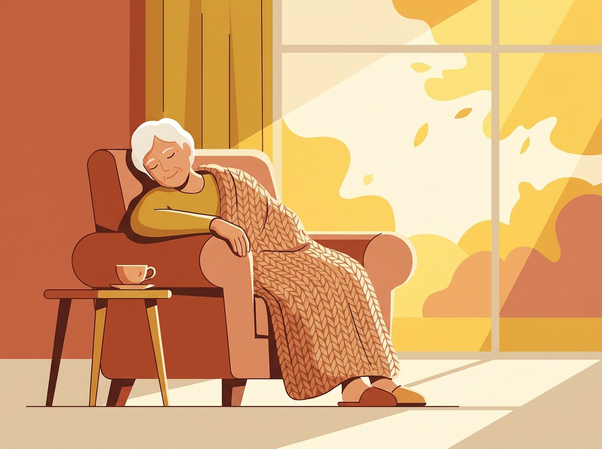
Picture this: your dad slept in until 9 a.m., a full ten hours in bed. By 2 p.m., he’s dozing off in his armchair again. If you’ve ever wondered why do older adults need naps even when they’ve clearly had enough hours of sleep, you’re asking a smarter question than you think.
Here’s the honest answer: it’s not about how long he slept. It’s about how well he slept. Ten hours in bed for an older adult can actually give less real rest than seven hours gives a younger adult. When someone needs a nap despite sleeping in, that’s a sign of sleep quality falling short, not sleep quantity.
Let’s break down why this happens, because once you understand it, that afternoon nap starts making a lot more sense.
Sleep Changes as We Age, Even If We Don’t Notice It
A full night of sleep isn’t one long, even stretch. It moves through cycles, and each cycle includes different stages, from light sleep to deep sleep to dreaming (REM) sleep. Deep sleep, also called slow-wave sleep, is the stage that does the most physical and mental repair work. It’s your body’s real recovery time.
As people get older, they simply spend less time in that deep sleep stage. According to Sleep Foundation research, deep sleep naturally decreases across the lifespan. The brain spends more of the night in lighter stages instead, the kind that don’t restore you nearly as well.
So even after eight or ten hours in bed, an older adult’s brain may not have gotten the deep, restorative recovery it actually needed. The nap later in the day becomes the body’s way of trying to catch up.
Related: Insomnia Treatment Plan: Simple Steps You Can Use Today
Broken Sleep Is More Common Than You’d Think
Here’s another piece of the puzzle: nighttime sleep for older adults tends to get interrupted a lot more easily. Instead of one solid stretch of sleep, it becomes several shorter stretches, broken up by small awakenings you might not even remember the next morning.
A few common culprits show up again and again:
- Nocturia — needing to get up and use the bathroom multiple times a night. This is extremely common. Sleep Foundation data shows 69% of men and 76% of women over 40 get up at least once a night to go.
- Physical discomfort — joint pain, arthritis, or muscle cramps that pull someone out of sleep without them fully waking up.
- Sleep apnea and restless leg syndrome — both become a lot more common with age, and both cause repeated, tiny interruptions through the night.
Sleep Foundation research backs up just how widespread this is: as many as 75% of older adults deal with some symptoms of insomnia. That’s three out of four people dealing with broken, restless nights on a regular basis.
When someone sleeps in late, they’re often unconsciously trying to make up for a night that was constantly interrupted. But here’s the thing: more hours in bed doesn’t fix fragmented sleep. The total sleep is still choppy and inefficient, even if the clock says they got plenty of rest.
The Body’s Internal Clock Gets Weaker With Age
There’s one more piece to this, and it’s a fascinating one. Deep in the brain sits a tiny structure called the suprachiasmatic nucleus, or SCN for short. Think of it as your body’s master clock. It’s the thing that tells you “stay alert” during the day and “get sleepy” at night.
In younger people, this clock sends strong, clear signals. Daytime feels awake and sharp. Nighttime feels heavy and sleepy. There’s a clear contrast between the two.
As we age, those signals naturally weaken. The line between “awake” and “sleepy” gets blurry. Instead of a clean day-night contrast, the brain struggles to stay fully alert all day and fully asleep all night. That’s exactly why a wave of sleepiness can hit an older adult in the afternoon, no matter how late they slept in that morning. The internal clock just isn’t drawing as sharp a line anymore.
Why Do Older Adults Need Naps If They Already Slept In?
So, Is Napping a Bad Sign? Not at all. A nap here and there is completely normal, and for older adults dealing with fragmented nighttime sleep, it’s often the body’s smart way of filling in the gaps. Sleep Foundation data shows 7% of adults nap every single day, and 81% have taken at least one nap of 10 minutes or longer in the past few months. It’s a common, normal part of how people sleep.
The key is balance. A short nap (20 to 30 minutes) earlier in the day usually doesn’t interfere with nighttime sleep. A long nap late in the afternoon might make it harder to fall asleep that night, which can feed right back into the same cycle.
What Can Help
A few small habits can make a real difference for older adults dealing with this pattern:
- Keep a consistent wake-up time, even on days when sleep felt rough the night before
- Get natural light exposure in the morning, since it helps reinforce that weakening internal clock
- Talk to a doctor about nighttime bathroom trips, joint pain, or snoring, since these are often treatable
- Keep naps short and earlier in the day rather than late afternoon
- Stay physically active during the day, which supports deeper, more consolidated sleep at night
Video Reveals: 30-Second Cherry Trick That STOPS 3 AM Wakeups & Restores Deep, Restful Sleep

Frequently Asked Questions
-
Why does my elderly parent need a nap even after sleeping 9-10 hours?
It comes down to sleep quality, not quantity. Older adults spend less time in deep, restorative sleep and experience more nighttime awakenings, so even a long night in bed may not deliver the same amount of real rest.
-
Is it normal for older adults to nap every day?
Yes, for many people it is. As nighttime sleep becomes more fragmented with age, daytime naps often become a natural way to make up for lost rest.
-
What is nocturia, and why does it get worse with age?
Nocturia is the need to wake up and urinate during the night. It becomes more common with age due to changes in bladder function, prostate size in men, and other age-related factors, and it’s one of the biggest causes of fragmented sleep in older adults.
-
Can improving sleep quality reduce the need for naps?
Often, yes. Treating underlying issues like sleep apnea, managing nighttime bathroom trips, and keeping a consistent sleep schedule can improve deep sleep and reduce daytime sleepiness over time.
-
When should napping be a concern?
If naps are very long, happen multiple times a day, or come with other symptoms like loud snoring, gasping at night, or extreme daytime fatigue, it’s worth mentioning to a doctor. These can be signs of an underlying sleep disorder rather than just normal aging.
Reference: Sleep Foundation. “126 Sleep Statistics: Facts and Data About Sleep.” https://www.sleepfoundation.org/how-sleep-works/sleep-facts-statistics